The Tall Man of the North Fork
The land remembers who loved it.
In those days the maps were still mostly lies.
They were clean lies, drawn in good ink by men who had never slept wet or gone hungry under a sky full of hard stars. They showed rivers as blue threads and mountains as little teeth. They did not show the cold. They did not show the mosquitoes. They did not show the way a horse could die standing in a bog or the way a man could lose his courage before breakfast and still have to go on.
We were sent north to measure the country.
That is what they called it. Measuring.
We carried chains and rods and notebooks wrapped in oilskin. We carried rifles and flour and coffee and salt pork gone slick in the heat. We carried letters from Washington and orders from men who wore clean collars. The land did not care for the letters. The mountains did not care for Washington.
The place had names already, though not ours. The Blackfeet knew the passes. The Kootenai knew the valleys. The Salish knew the trails where the deer crossed and where winter killed the foolish. But the government wanted lines. Lines across rivers. Lines through timber. Lines over places no line could own.
I was younger then. My beard had more brown in it and my knees did not speak to me each morning. I believed maps mattered.
Then I met him.
It was on the North Fork, in the timber where the river ran cold and fast over stones green with age. I had gone ahead of the party to find a sightline. The trees were thick and the clouds had come down low, and the mountains were hidden like old sins. I heard something moving above me on the slope. Not a bear. A bear is loud because he has never had to be quiet.
This was quiet.
I raised the rifle.
He stepped from the cedar shade and looked at me as if he had been expecting me for years.
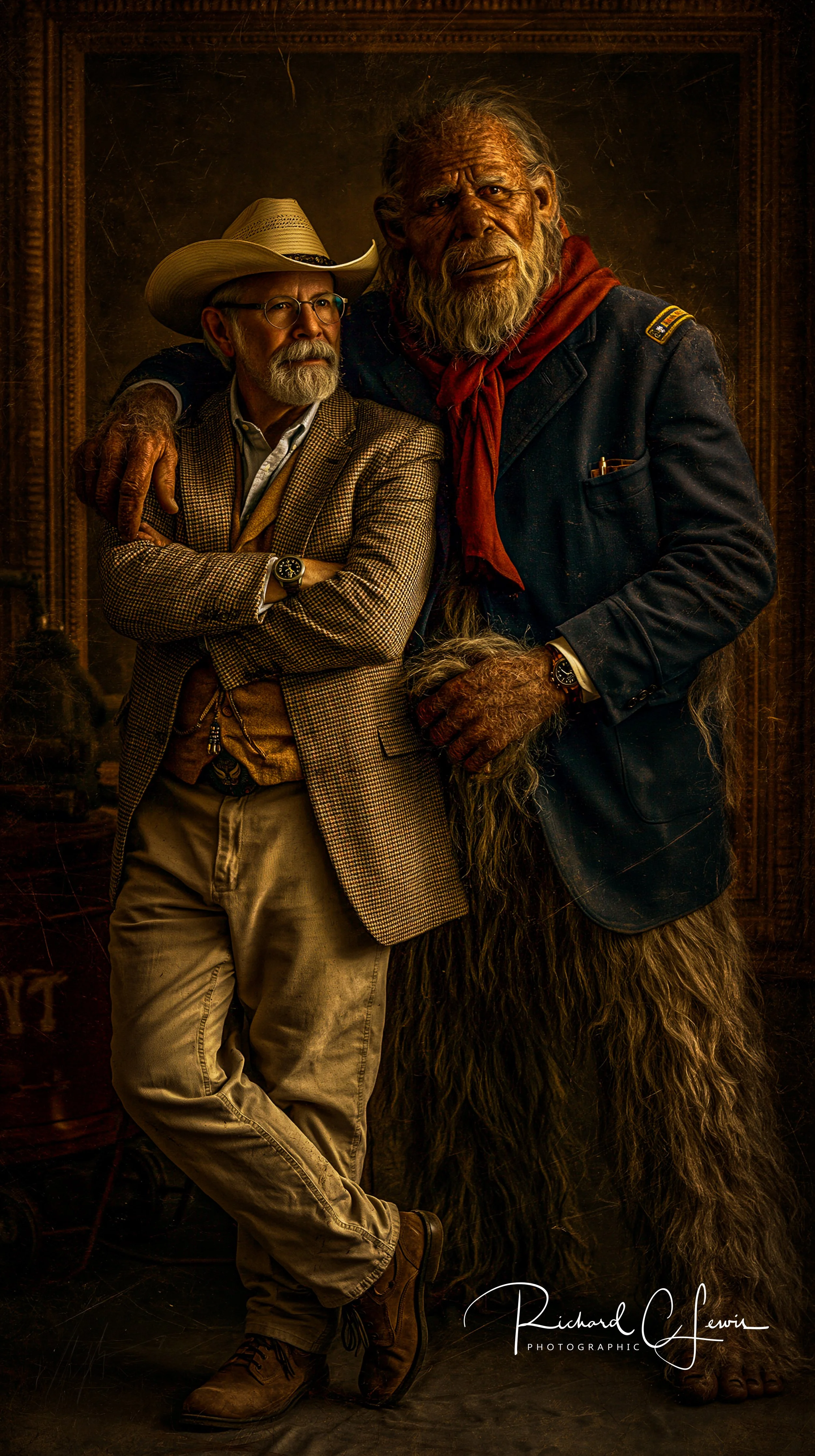
He was taller than any man I had seen. His shoulders were broad as a cabin door. His hair was gray and brown and hung long over him like winter grass. His face was not the face of a beast. That was the first thing I knew. It was old and grave and full of trouble. His eyes were amber in the dim light, and there was a sadness in them that made me lower the gun before I knew I had done it.
He looked at the rifle. Then at me.
“You lost?” I asked.
He made no answer.
The river talked for both of us.
I took tobacco from my pouch and set it on a flat stone between us. My hand shook some, though I would not have admitted it then. He watched the tobacco. Then he reached into the hair at his chest and brought out a small smooth stone, white as bone, worn by water. He placed it beside the tobacco.
That was our treaty.
Not Washington’s. Ours.
We called him Amos after that, though I do not know if he liked the name. He had a name of his own. I heard it once from an old Blackfeet woman who saw him at a distance and crossed herself in a way that was not Christian. She said something soft and ancient. It meant, as near as I could learn, He Who Walks Before Snow.
Amos was easier for white men. White men are fond of making easy names for things they do not understand.
He stayed near us through that summer.
Not always in sight. Never in camp unless the fire was low and the men were asleep. But he was there. We would wake and find a haunch of deer hung from a branch. We would find berries piled in a tin cup. Once, after three days of rain, when the matches were wet and the men had gone mean with cold, he came out of the dark carrying coals cupped in a piece of bark like he was carrying a child.
No man laughed at him after that.
We crossed country that would later be called Glacier, though no one owned that name yet. The mountains rose clean and terrible above us. Snow lay in the high cuts even in August. The lakes were blue in a way no ink could hold. There were goats on cliffs where no living thing should stand, and eagles that looked down on us as if we were temporary.
Amos knew every pass.
He knew where the wind would turn before it turned. He knew when the horses would spook and when the ice would break. He knew which berries were good and which would make a man pray for death and mean it. He knew the old trails. He never walked on them unless he had to. He walked beside them, among the trees, as if he did not wish to wear them down.
One evening we camped below a wall of red stone. The sun was dying behind the peaks, and the whole west burned like a forge. I sat with my notebook on my knee and tried to draw the valley. Amos sat near the fire, his great hands folded. He had taken to wearing an old cavalry coat one of the men had traded him for a silver watch that did not run. The coat was too small across his shoulders, but he wore it with dignity.
“You understand what we are doing?” I asked him.
He looked at me.
“We are marking it,” I said. “The rivers. The ridges. The boundaries.”
He looked toward the mountains.
I laughed then, but there was no mirth in it.
“Yes,” I said. “It is a fool’s work.”
He reached for a stick and drew a line in the dirt. Then he wiped it away with the flat of his hand.
That was all.
It was the finest argument I ever heard.
There was a man with us named Bell. He was from Ohio and had come west to become something larger than he was. That is a dangerous reason to come west. The country will make you smaller first, and if you survive that, it may make you honest.
Bell feared Amos. Men often hate what they fear, and Bell was no exception. He said the creature should be reported. He said a specimen would bring money. He said museums in the East would pay. He said science required proof.
“Science requires humility,” I told him.
He spat into the fire.
“Then you have chosen the wrong profession,” he said.
He was right about that, maybe.
The trouble came near Marias Pass.
Snow fell early. It came in the night, heavy and wet, and by morning the world had been remade without asking us. The horses were half mad. One mule broke a leg in the rocks and had to be shot. The sound went flat against the snow and did not echo.
We pushed on because Bell insisted the pass was near and because I was too proud to turn back.
Pride is a compass that points mostly toward graves.
By afternoon the storm closed hard. We lost the line of trees. We lost the trail. We lost one another in thirty yards of white. A young chainman named Ellis slipped on a shelf of ice and went over a cutbank into timber below. We heard him cry once. Then nothing.
Amos moved before any of us could speak.
He went down the bank like falling rock. We could not see him. We heard branches break. We heard the storm. We waited with ropes around our waists and snow filling our collars.
After a long time he came back carrying Ellis against his chest. The boy’s leg was broken and his face was gray. Amos climbed with one hand and held the boy with the other. No man had strength like that. No man had gentleness like that either.
Ellis lived because of him.
Bell saw it. We all saw it.
That night we made camp in the lee of a broken cliff. Amos sat outside the firelight. Snow gathered on his shoulders and did not melt. Bell came to him with a tin cup of coffee. His hand shook.
“I was wrong,” Bell said.
Amos took the cup carefully between two fingers.
Bell stood there a moment, small and cold and human.
“I am sorry,” he said.
Amos drank the coffee. He made a face at the bitterness, and for the first time I saw him smile.
It nearly broke me.
There are things too large for laughter and too tender for words. That smile was one of them.
When spring came we finished the survey. Or said we did. The notebooks were filled. The bearings were checked. The rivers had numbers. The peaks had names given by men who would not climb them. We packed the instruments and started south.
Amos followed us for three days.
On the fourth morning he did not come.
I found his tracks near the river. Large tracks. Deep in the mud. They led north toward the dark timber and the snowfields beyond. Beside them were the prints of deer and wolf and bear. Above them the peaks stood clean against the morning.
I wanted to follow.
I did not.
A man spends much of his life not following what he loves.
Years passed. The country filled with fences, roads, survey stakes, claims, uniforms, tourists, postcards, and names. Men came to see the mountains and said they had discovered beauty. Beauty had been there all along, waiting with more patience than we deserved.
I grew old.
My hands became poor at fine work. My eyes watered in the wind. I kept the white stone Amos had given me in a small leather pouch. When the pain was bad or the world became too loud with engines and argument, I held it in my palm and remembered the North Fork. I remembered wet cedar. I remembered coffee smoke. I remembered a great gray hand wiping a line from the dirt.
Near the end of my surveying years I went back alone.
I was too old for the trip and knew it, which is sometimes the only proper reason to go. I rode north with one horse and little gear. The mountains were still there. They had not missed me. The river was still cold. The wind still came down from the high places with teeth in it.
At dusk I made camp where we had first met.
I set tobacco on the same kind of flat stone. My hands were stiff and I spilled some. Then I placed the white stone beside it.
“I came to give it back,” I said.
The timber was quiet.
“I have carried it long enough.”
Nothing moved.
The light faded. The river ran black. I felt foolish, but grief makes fools of better men than me.
Then from across the water came a sound.
Not a call. Not a roar.
A low breath. A knowing.
He stepped from the trees.
Older. Much older. His hair was pale now, nearly silver. One shoulder hung lower than the other. But his eyes were the same. Amber and tired and kind.
I stood, but my knees failed me some. He crossed the river without hurry, water breaking around him. When he reached me, he looked at the stone, then at my face.
“I kept it safe,” I said.
He picked up the stone and held it. Then he pressed it back into my hand.
I understood.
Some gifts are not meant to be returned.
We sat by the fire as the stars came on. I told him about the men who had died and the men who had prospered and the land that had been measured and sold and praised and wounded. I told him I was sorry, though sorry is a poor tool and fixes almost nothing.
He listened.
Before dawn he rose. He placed one great hand on my shoulder. It was heavy and warm. For a moment I was young again, and the map was blank, and the world had not yet been divided.
Then he turned north.
At the edge of the trees he stopped once and looked back.
I wanted to call out. I wanted to ask him not to go. I wanted to ask if he had forgiven us.
But the old ones do not owe answers to the young. And we were all young beside him.
So I raised my hand.
He raised his.
Then He Who Walks Before Snow went into the timber, and the timber took him as a mother takes back a child.
I never saw him again.
But sometimes, when the first snow comes to Montana and the mountains disappear behind their own weather, I think of him walking ahead of the storm. I think of his great feet making the first marks in the white country. I think of all the lines we drew and all the lines the snow erased.
And I know this.
The land remembers who loved it.
Even when men do not.