The Line That Held the Country
But some lines are not made of ink.
We met in Livingston in a saloon with a carved oak bar and lamps that smoked in the glass. The place was called Moran & Liss, though no man I knew had ever seen either Moran or Liss. The whiskey was honest and the coffee was not. That was enough.
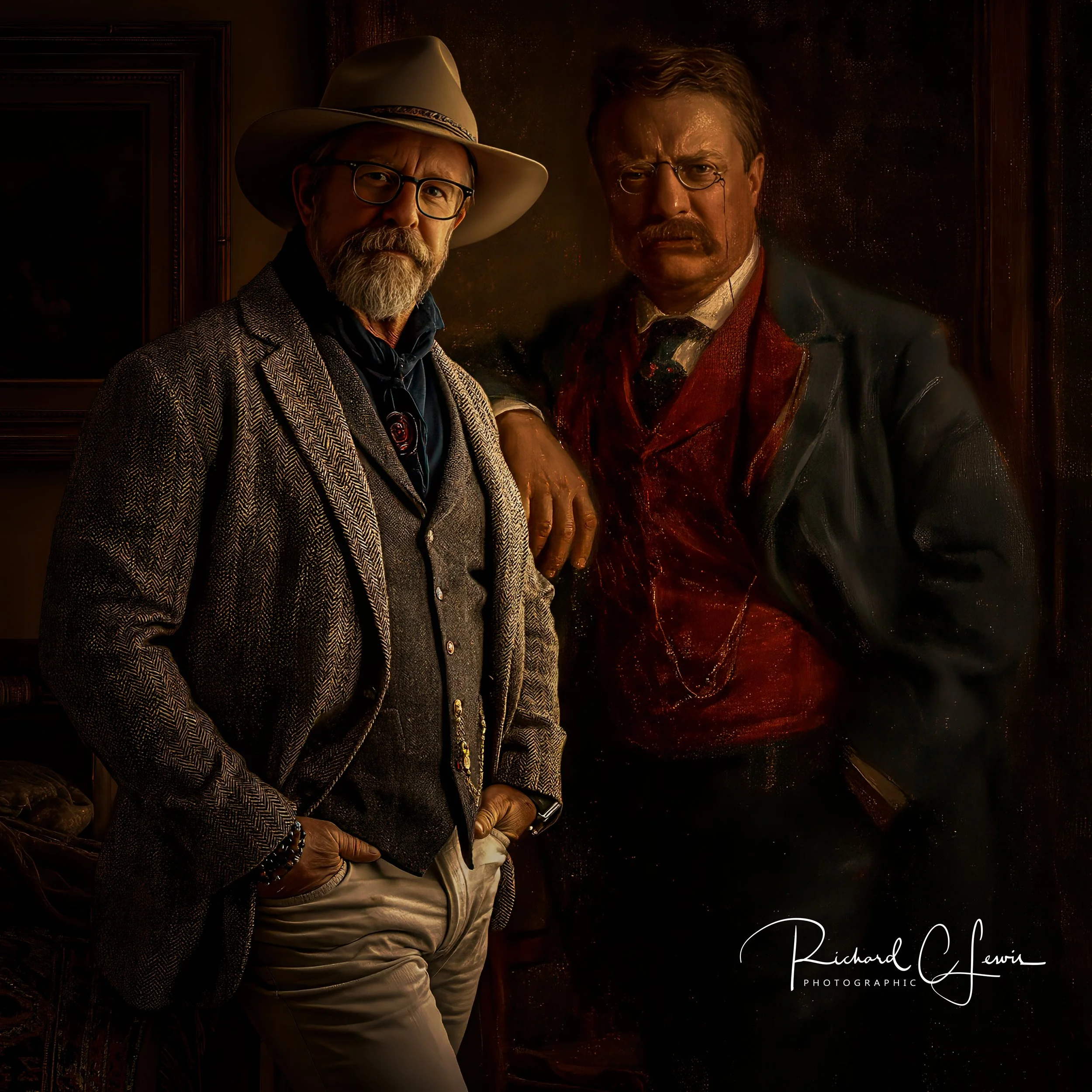
Roosevelt stood by the bar with one hand around a glass and the other hand inside his coat. He was younger than the pictures would later make him, but already he had the look of a man who had decided the world would not be allowed to beat him, though it had tried very hard.
His spectacles caught the lamplight. His mustache was trimmed like a challenge.
“You are the man who knows the country,” he said.
“I know some of it.”
“That is better than most men who claim all of it.”
He smiled then, but not much. He had come west after sorrow. Everyone knew it and no one said it. His wife had died. His mother had died. Same day. A blow like that either hollows a man out or makes a new country inside him. With Roosevelt you could see both things happening.
On the table between us lay a survey map of the Yellowstone country. It was wrong in three places before breakfast and dangerous in two after dark. The mountains were drawn too clean. The rivers were too obedient. The blank places on the paper were not blank if you had ridden through them. They had bears in them, and wolves, and steam from the earth, and Indians who knew the old trails, and men with rifles who believed a boundary was only a suggestion until somebody bled for it.
Roosevelt tapped the map.
“They say this is a park.”
“It is.”
“They say the government has set it aside.”
“It has.”
“But lines on paper do not keep men honest.”
“No,” I said. “Only other men do.”
He looked at me then, hard and pleased.
“Then we shall ride.”
We left before sunrise with two packhorses, a surveyor named Pike, and a Crow scout called Red Plume, who did not waste words because he had seen what words were worth among white men. Frost lay silver on the grass and the Yellowstone River moved beside us, dark and cold and alive. The horses blew steam. The mountains stood blue against the morning.
Roosevelt rode badly at first, but he rode with appetite. That was the thing about him. He attacked discomfort as if it were an animal. The saddle hurt him, so he sat deeper. The cold cut him, so he laughed. The wind hit his face, and he bared his teeth at it.
By noon we were in open country. The sky widened until a man felt small enough to tell the truth. We saw elk moving in the timber and antelope bright on the flats. Once we stopped above a valley where the grass bent and moved as if the earth itself were breathing.
“Buffalo,” Red Plume said.
There were not many. Not like before. Not like the stories. They moved slowly, dark and heavy, with calves among them. Roosevelt took off his hat.
No one spoke for a while.
“That,” he said finally, “is America before the counting men got to it.”
Pike, the surveyor, shifted in his saddle.
“Counting men made this park, Colonel.”
“He is not a colonel,” I said.
“Not yet,” Roosevelt said.
He smiled again, and this time there was some boy in it.
We camped near a creek that night. The land smelled of sage and horse sweat and woodsmoke. Pike worked by lantern, scratching figures into his book. Red Plume sat apart and watched the dark. Roosevelt cleaned his rifle though it did not need cleaning. I made coffee strong enough to float a horseshoe.
“There are men in Washington,” Roosevelt said, “who think land is saved when ink dries.”
“There are men out here who think land is theirs when they cut a tree.”
“And what do you think?”
“I think the land was never ours. Not really.”
He looked across the fire.
“That is a lonely thought.”
“It is an honest one.”
The fire cracked. Somewhere far off a wolf called. Another answered, higher up, toward the black timber.
Roosevelt listened.
“I came here because I had to,” he said.
I said nothing.
He turned the rifle in his hands.
“There was a house in New York. There was a nursery. There were flowers on a table. I remember the flowers more clearly than I remember the words they said to me. That is a strange cruelty of the mind. It keeps the flowers.”
The fire burned low.
“I thought if I rode far enough, I might come to a place where grief could not follow.”
“Did you?”
“No.”
He looked toward the sound of the wolves.
“But out here it has to ride hard to keep up.”
That was the first true thing he said to me.
The next day the weather turned. It came out of the northwest, hard and mean, with sleet like thrown gravel. We climbed toward the high country where the map showed a clean boundary line and the country showed nothing clean at all. The horses slipped on shale. Pike cursed the government, the mountains, and his own boots. Red Plume moved as if weather were no more than another man talking too much.
Near the pass we found the first dead elk.
Then another.
Then we saw the tracks.
Two men had been there with pack animals. They had taken hides and tongues and left the bodies for birds. They had crossed into the protected ground, though no sign stood there and no fence marked it. Only the map. Only the idea. Only the promise.
Roosevelt knelt beside one of the elk. The sleet ran down his hat brim.
“This is not hunting,” he said.
“No.”
“This is theft from men not yet born.”
That stayed with me. I had never heard it put that way. Men not yet born. Children who would come west years later with clean eyes and ask where the herds had gone. Fathers who would stand with them and have no answer good enough. Pain travels forward. So does duty.
We followed the tracks down into timber.
The poachers had made camp in a draw out of the wind. There were three of them, not two, and one had a buffalo robe over his shoulders. They had rifles stacked against a log and meat hanging from poles. One was cooking. One was sleeping. The third saw us first.
He went for his rifle.
Roosevelt was off his horse before I could speak.
“Leave it,” he shouted.
The man stopped because Roosevelt’s voice had the kind of force that made obedience seem like your own idea.
“This is public land,” the man said.
“It is protected land.”
“Protected by who?”
Roosevelt stepped forward.
“By me, for the present.”
That was a foolish thing to say and a brave one. Often they are kin.
The man laughed and spat into the fire.
“You some eastern dude playing sheriff?”
Roosevelt’s face changed. It did not grow angry. It grew still.
“I am a citizen of the United States,” he said. “And I am telling you that this slaughter ends here.”
The man looked at me. Then at Red Plume. Then at Pike. Then back at Roosevelt. He was deciding how many ghosts he wished to make before supper.
Red Plume lifted his rifle slightly. Not much. Enough.
No one died that day. That was the best thing that happened.
We took their rifles until morning and marked their names. Pike wrote them down with great satisfaction, as if ink had finally found a useful purpose. Roosevelt made the men bury what they could and burn what they could not. The air stank of wet ash and wasted life.
That night Roosevelt did not sleep. I found him near the creek at dawn. Snow had fallen and softened everything. He was standing bareheaded, looking east where the first light came pale over the ridges.
“You cannot save it all,” I said.
“No,” he said. “But that is no excuse to save nothing.”
Below us the creek moved under ice. Above us the mountains stood without concern for our small griefs and smaller victories.
“My father taught me,” Roosevelt said, “that a man must spend himself on worthy things.”
“He taught you well.”
“He died before I could become the man he expected.”
“Maybe that is why you are still becoming him.”
He turned then. His eyes were wet, though the cold gave him cover.
There are moments between men when nothing should be said. If you speak, you cheapen it. So we stood there with the snow falling on our hats and shoulders, and the horses stamping in the trees, and the whole Yellowstone country lying quiet as if it had decided to listen.
Later that morning we rode to the ridge Pike needed for his sighting. The clouds opened. Sun struck the valley below, and steam rose from the distant thermal basins like breath from some sleeping animal older than scripture. The river shone in pieces. Elk moved along the timber edge. Far off, the remaining buffalo crossed a meadow, slow and dark and stubborn.
Pike set his instrument and cursed less than usual. Red Plume watched the horizon. Roosevelt stood beside me.
“There,” he said. “That is what they must understand.”
“Who?”
“All of them. Congress. Ranchers. Soldiers. Boys not yet born. Men who think money is memory.”
He took the map from his coat and held it against the wind.
“A park is not land removed from use,” he said. “It is land given a higher use.”
The wind snapped the paper in his hands.
I looked at the valley and thought of all the men who had tried to own what could only outlive them. I thought of the dead elk. I thought of Roosevelt’s flowers in New York, still blooming in the cruel room of his mind. I thought of how a man sometimes saves a place because he could not save a person.
That was when I understood him.
He was not running from grief. He was giving it work.
We rode back to Livingston three days later. The saloon was warm and loud and full of men improving their stories. Moran & Liss still had no Moran and no Liss. The whiskey remained honest. Roosevelt drank one glass and pushed it away.
“You will ride with me again,” he said.
It was not a question.
“When?”
“When there is something worth fighting for.”
“That is most days out here.”
“Bully,” he said.
I laughed then, and so did he.
Years later, people would speak of him as if he had been born bronze. They would put him on mountains and in books and make him larger than hunger, larger than sorrow, larger than any man ought to be. But I knew him when his grief was still fresh and his hands were cold around a tin cup of coffee. I knew him when the West had not yet cured him but had taught him how to stand.
And I knew this too.
The line Pike drew on that map was thin. Any fool could cross it. Many did.
But some lines are not made of ink.
Some are made of men who stand in the weather and say no.
Some are made of what we owe the dead.
Some are made of what we owe the children.
And some, if they hold long enough, become a country.