The Fire in the Timber
The road ended where the trees began to keep their own counsel.
We had come up from Bozeman in the late afternoon with the camper pulling hard behind the truck and the mountains blue and far off, like old men who had seen enough of weather to stop speaking of it. There were three of us. Tom drove. I sat beside him with the map folded wrong in my lap. Behind us, Clay slept with his hat over his face and his boots crossed like he owned the whole state of Montana and half of Wyoming besides.
We were not young, though we still lied about it in the way men lie when they climb into trucks before dawn. We said our knees were fine. We said the coffee was strong enough. We said the road was easy.
The road was not easy.
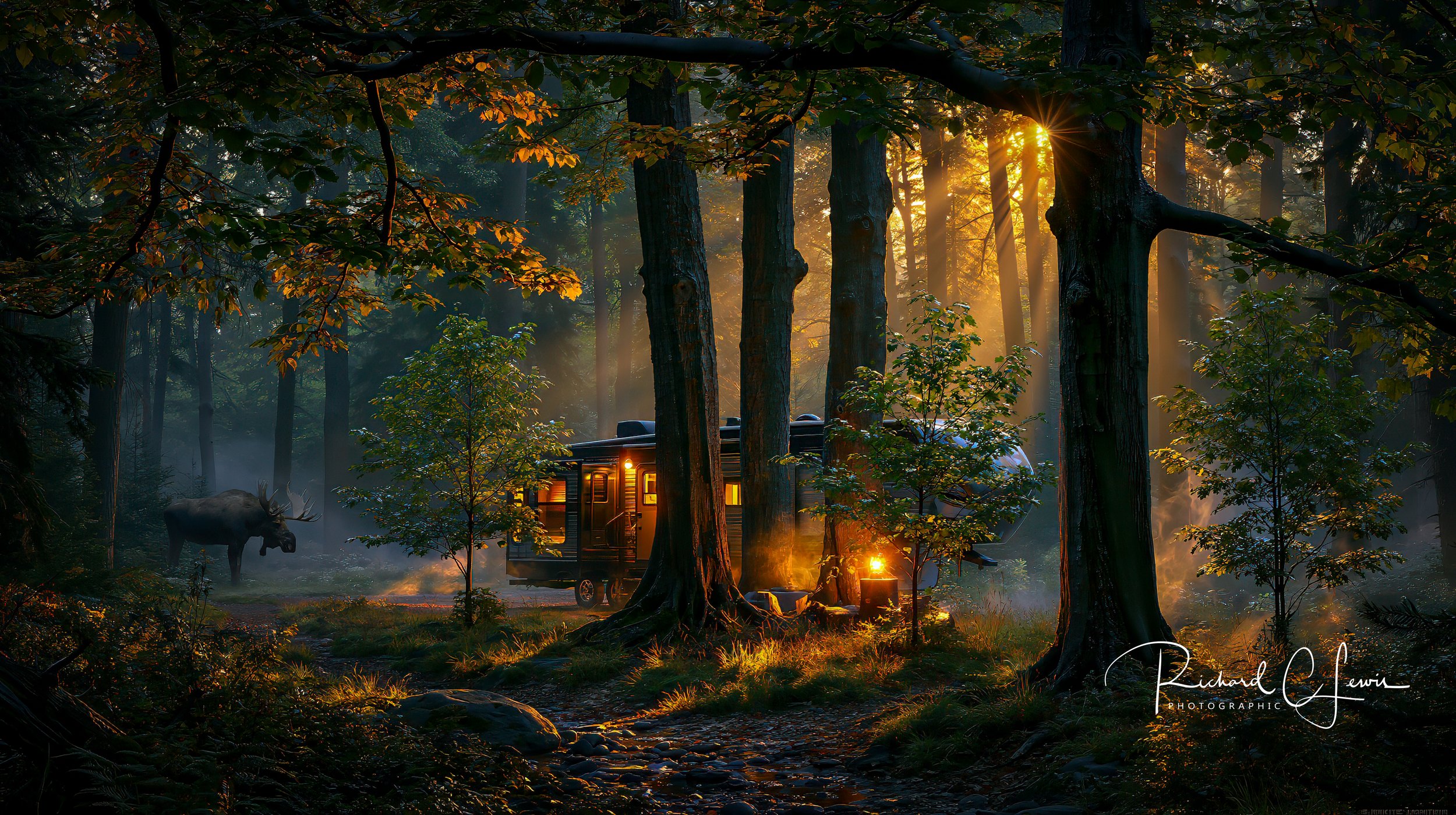
It climbed through lodgepole and fir and then dropped into a dark piece of forest where the sun came low through the timber and made gold of everything it touched. The leaves burned orange above us. The creek ran thin and cold over stone. Mist hung in the low places. It was the kind of evening that made a man quiet, even if he had spent most of his life avoiding quiet.
“This will do,” Tom said.
And it did.
We leveled the camper between three big trees and set the chocks under the wheels. Clay gathered wood. I made coffee on the camp stove and watched the light move through the forest like something alive. We had brought too much food, not enough whiskey, and just enough pride to be dangerous.
A moose came out of the timber before dark.
He was a bull, heavy and black-shouldered, with antlers wide as a gate. He stood in the mist near the creek and looked at us as if we were late to an appointment he had been keeping for a thousand years. No one reached for a camera at first. No one spoke.
That was good.
There are things a man ruins by trying to own them too quickly.
The moose lowered his head and tore at the willow. He was not afraid of us. He was not impressed by us either. He had winter ahead of him and a forest behind him and all the dignity a creature can carry without knowing the word for it.
Clay finally whispered, “Big son of a gun.”
The moose lifted his head.
“Respectfully,” Clay added.
Tom laughed under his breath.
We watched until the bull walked back into the dark trees and vanished so completely it seemed he had never been there at all.
That night the fire burned clean and orange. The camper windows glowed behind us. The forest closed in, not cruelly, but firmly. There is a difference. The stars came late because the trees held the sky in pieces.
We ate trout Clay had caught that morning and potatoes fried in a pan blackened by old fires. Tom told the story of the time he got lost above the Madison and followed elk tracks the wrong way for five miles. Clay said that was not being lost. That was being confidently incorrect with scenery.
We laughed hard at that. Harder than the joke deserved. Men do that when they are tired and grateful and no longer trying to prove anything.
Later, after the plates were cleaned and the fire settled low, Tom spoke of his brother who had died the winter before. He did not make a speech of it. He only said his brother would have liked the place.
No one answered right away.
The creek spoke for us.
Then Clay put another log on the fire, and I poured the last of the whiskey into three cups. It was not enough for three cups, but it was enough for three men.
“To him,” I said.
“To him,” they said.
The forest took the words and kept them.
In the morning, the cold was honest. It came through the camper walls and found every old injury we had brought with us. My back ached. Tom’s hands were stiff. Clay cursed one boot, then the other, then the entire invention of laces.
But the sun came through the trees again, and the whole place was made new.
We packed small bags and hiked west, toward a ridge Tom had marked on the map. The trail was not much of a trail. It was an argument between stones, roots, and gravity. We followed it anyway. A man should do that sometimes. Follow a hard thing simply because it is there and because something in him grows smaller when he does not.
By noon we had climbed high enough to see the country open below us. Montana stretched out in folds of timber and meadow, river and rock, light and distance. Far away, the mountains stood blue and indifferent.
Clay sat on a fallen log and took off his hat.
“Well,” he said, “that’s worth the price of admission.”
“There was admission?” Tom asked.
“Your knees paid it.”
We ate sandwiches in the wind. They were smashed flat and tasted better than anything made by a chef with clean fingernails. A raven crossed above us. Somewhere below, in the timber, a branch broke with the heavy sound of an animal moving unseen.
That was the bargain out there. You saw some things. You did not see others. The unseen things were part of the price, and maybe part of the mercy.
On the way down, the weather changed.
Clouds came over the ridge fast and hard. The light went out of the forest. Rain began as a whisper and then became serious. The trail slicked under our boots. We had prepared, but not perfectly. No one ever does. We had good coats and bad timing. We had a map and too much confidence. We had friends, which was better.
Tom slipped once and caught himself against a spruce. Clay took his pack without asking. Tom said he was fine. Clay said nothing and kept the pack.
That is how men love each other when they have not been trained in poetry.
The rain turned cold. The creek we had crossed in the morning had swollen by the time we reached it again. It was not deep enough to kill us, but it was deep enough to make fools of us, and the water in Montana is always pleased to do that.
We stood at the bank and studied it.
“Could wait,” I said.
“Could,” Tom said.
“Won’t get warmer.”
“No.”
Clay looked upstream, then down. “We cross slow. One at a time. No hero work.”
That was the best thing said all day.
We crossed slow. Boots sliding. Poles searching. Water pressing hard at the shins. Halfway across, I felt the current take me. Not much. Just enough. Enough to know how little separates a man from being carried away.
Then Tom’s hand was on my shoulder.
Clay’s hand was on Tom’s pack.
Three old fools in a creek, holding one another against the pull of the world.
We made the far bank wet and shaking and alive. The camper was not far then. The firewood was under the tarp. The coffee was waiting to be made. These were small things, and small things are not small when you have earned them.
That evening, the moose came back.
He stood closer this time, at the edge of the firelight. Steam rose from his body. Rain shone on his coat. Behind him the forest was black and deep and full of the old laws.
He looked at us, and we looked at him.
I thought then of the fisherman alone on the sea, with his hands cut and his back bent and the great fish pulling him farther from shore. I thought of how a man may lose the thing he fought for and still come home with something no teeth can strip from him.
The moose had no need to teach us. The forest had no need to explain itself. But a man who pays attention can learn even when no lesson is being offered.
Keep going when the days are empty.
Respect what is stronger than you.
Sit alone sometimes, but do not mistake loneliness for courage.
Prepare well, because weather does not care about optimism.
And when the sharks come, or the rain, or age, or grief, or the creek rising cold against your legs, remember this: the trophy is not always what you carry home. Sometimes it is how you crossed.
We sat by the fire until the last log broke and settled into embers.
Tom talked about his brother again. This time he smiled.
Clay said nothing, but he put his cup near Tom’s and left it there.
Above us, the trees held the dark. Beyond them, the stars burned clean and far away. The camper glowed behind us, warm and small in all that wilderness, and for a while it seemed enough.
More than enough.
We had come to Montana looking for elk, trout, photographs, and a good road into the backcountry.
What we found was older than that.
We found that a man should choose his company carefully, because the wrong men make the wilderness smaller, and the right ones make your courage larger. We found that friendship is not noise around a fire, but a hand on your shoulder in cold water. We found that the forest does not love you, but it may let you pass through if you walk humbly.
And we found, as all men must find if they live long enough, that the world will take pieces of what you love.
Let it try.
There are fires it cannot put out.